

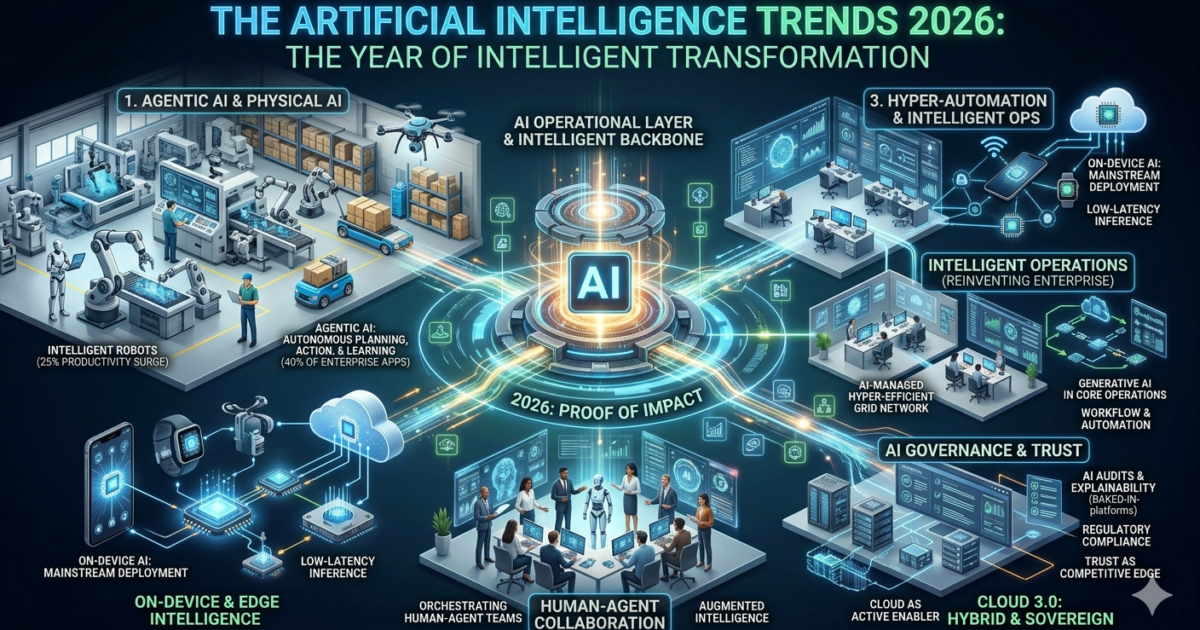
As we navigate through 2026, artificial intelligence has moved beyond the experimental phase into the realm of tangible business transformation. What started as promising proof-of-concepts in 2023 and 2024 has evolved into production-ready solutions driving measurable outcomes across industries. The AI landscape has fundamentally shifted from asking “can it work?” to “how can we scale it?”
This year marks a critical inflection point where artificial intelligence trends 2026 are no longer just technological novelties but essential business imperatives. With AI companies raising a record $225.8B in 2025, nearly double 2024’s total, and people adopting AI faster than they picked up the personal computer or the internet, we’re witnessing the emergence of a truly intelligent economy.
The Rise of Agentic AI: Beyond Automation to Autonomous Intelligence
The most transformative among artificial intelligence trends 2026 is the explosive growth of AI agents—autonomous systems that can plan, reason, and execute complex tasks with minimal human intervention. 83% of organizations surveyed in the 2025 Cisco AI Readiness Index planned to deploy agentic AI systems, marking this as what many consider “the year of the agent.”
Unlike traditional automation tools that follow pre-programmed rules, AI agents represent a paradigm shift toward truly intelligent systems. Gartner predicts 40% of enterprise applications will be integrated with task-specific AI agents by 2026, up from less than 5% today. This dramatic acceleration reflects not just technological advancement, but a fundamental reimagining of how work gets done.
The practical applications are already yielding impressive results. One major retail company began by using AI agents to cut software development cycle times and reduce production errors by half or more, then scaled across HR, finance, supply chain and marketing. Meanwhile, the most common applications of AI agents include autonomous customer service bots, AI-driven recruiting assistants, sales outreach and lead qualification agents, financial report generation, market monitoring, and automated cybersecurity threat detection.
The Evolution Beyond Single-Task Agents
The sophistication of AI agents is rapidly evolving. By 2027, Gartner predicts one-third of agentic AI implementations will combine agents with different skills to manage complex tasks within application and data environments. This collaborative approach represents a shift from isolated task automation to orchestrated intelligent workflows that can handle enterprise-level complexity.
However, implementation challenges remain significant. The real challenges are those rooted in organizational change: the ability to connect AI agents across applications and workflows (19%), organizational change to keep pace with AI (17%) and employee adoption (14%). Success requires not just technological deployment, but comprehensive organizational transformation.
Multimodal AI: The Convergence of Human-Like Perception
Among the most exciting artificial intelligence trends 2026 is the maturation of multimodal AI systems that can simultaneously process text, images, audio, and video. Input possibilities expand beyond just text; we can now do speech-to-text, text-to-video, image-to-text, and more, enabling AI systems to interact with the world in increasingly human-like ways.
The market momentum is extraordinary. The global multimodal AI market was valued at $1.73 billion in 2024 and is projected to reach $10.89 billion by 2030, growing at a CAGR of 36.8%. This growth reflects the technology’s progression from research curiosity to practical business tool.
Leading the charge are sophisticated models like GPT-5, OpenAI’s most advanced multimodal model, capable of understanding and generating text, images, and code simultaneously, with unified architecture that enables real-time reasoning across multiple modalities and improved safety features with reduced hallucinations.
Breaking Through the Efficiency Barrier
A crucial development in multimodal AI is the focus on efficiency over pure scale. The rapid success of large multimodal models has largely followed a simple rule: bigger models trained on more data tend to perform better. However, this scaling strategy comes at a steep price, requiring enormous computing resources, high energy consumption, and centralized cloud infrastructure.
The solution lies in architectural innovation rather than brute force scaling. An 8-billion-parameter MMaDA model outperforms LLaMA-3-7B and Qwen2-7B on text reasoning, and beats state-of-the-art image generators like Stable Diffusion XL on text-to-image tasks. Another approach, EBind, shows that carefully binding embedding spaces of multiple modalities can surpass much larger models (4–17× bigger).
The Productivity Revolution: Measurable Impact on the Workplace
Perhaps the most tangible manifestation of artificial intelligence trends 2026 is in workplace productivity. The data reveals both impressive gains and nuanced challenges in how AI is reshaping work.
Workers using generative AI reported they saved 5.4% of their work hours in the previous week, which suggests a 1.1% increase in productivity for the entire workforce. While this might seem modest, it represents significant economic value when scaled across the entire economy.
The productivity gains are particularly pronounced in specific sectors. AI is boosting productivity by 14% in customer service and 26% in software development, according to research cited by the index, but such gains are not seen in tasks requiring more judgment. This pattern suggests that AI’s impact is most powerful when augmenting routine cognitive tasks rather than replacing complex decision-making.
The Reinvestment Phenomenon
Contrary to fears of mass layoffs, organizations are largely channeling AI productivity gains into growth rather than workforce reduction. Nearly all organizations investing in AI are experiencing some amount of AI-driven gains in productivity (96%), including 57% that say their gains are significant. Among organizations experiencing AI-driven productivity gains, only 17% say these gains led to reduced headcount.
Instead, companies are pursuing a reinvestment strategy. Organizations that shift from a productivity mindset to a growth agenda are using AI to drive innovation, create new markets and achieve what was previously considered impossible. This approach transforms AI from a cost-cutting tool into a value-creation engine.
The Skills Premium Effect
One of the most encouraging findings in workplace artificial intelligence trends 2025 is that AI is making workers more valuable, not less. AI is making workers more valuable, with wages rising twice as quickly in those industries most exposed to AI compared to those least exposed. This suggests that rather than replacing human workers, AI is enhancing their capabilities and market value.
There’s a 43% wage premium for AI skills comparing workers in the same job with and without AI skills, up from 25% last year. This premium reflects the scarcity of AI-literate workers and the value that organizations place on employees who can effectively leverage AI tools.
The Global AI Competition: A New Geopolitical Landscape
Among the defining artificial intelligence trends 2025 is the intensifying global competition for AI leadership, with profound geopolitical implications. In a long, heated race with immense geopolitical stakes, the US and China are almost neck and neck on AI model performance. In early 2023, OpenAI had a lead with ChatGPT, but this gap narrowed in 2024. In February 2025, DeepSeek’s R1 briefly matched the top US model. As of March 2026, Anthropic leads, trailed closely by xAI, Google, and OpenAI, while Chinese models lag only modestly.
This competition extends beyond pure technological capabilities to global adoption patterns. This rapid evolution underscores an increasingly important dimension of AI competition between the United States and China, involving a race to promote adoption of their respective national models. DeepSeek’s success reflects growing Chinese momentum across Africa, a trend that may continue to accelerate in 2026, underscoring how global AI diffusion is influenced by accessibility factors.
The stakes are becoming clearer as AI adoption reaches unprecedented levels. Global adoption of artificial intelligence continued to rise in the second half of 2025, with roughly one in six people worldwide now using generative AI tools. New data shows the world is using AI at record levels, with global adoption reaching 16.3 percent of the world’s population.
The Infrastructure Investment Race
Behind these competitive dynamics lies an unprecedented infrastructure investment race. AI companies are generating revenue faster than companies in any previous technology boom, but they’re also spending hundreds of billions of dollars on data centers and chips. This massive capital expenditure reflects the belief that AI infrastructure will become as fundamental to national competitiveness as traditional infrastructure.
The concentration of investment is particularly striking. OpenAI, Anthropic, and xAI raised a combined $86.3B in 2025 — 38% of total AI funding. In Q4’25, their $46B in funding represented over half of the quarter’s total. Even as these companies burn through cash to meet AI development costs, investors appear confident in their growth potential.
Emerging Frontiers: Physical AI and Robotics Revolution
One of the most exciting artificial intelligence trends 2025 is the emergence of physical AI—AI systems that can interact with and manipulate the physical world. AI advances are enabling robots to perform increasingly complex tasks across diverse environments, from manufacturing floors to the battlefield. Top rounds in 2025 went to companies across defense applications (Helsing, Anduril, Saronic), humanoid robotics & models (Figure, Physical Intelligence, Skild), and autonomous driving (Applied Intuition, Neolix).
This convergence of AI intelligence with physical embodiment represents a fundamental shift from purely digital applications to systems that can operate in the real world. The implications extend far beyond traditional robotics, encompassing autonomous vehicles, smart manufacturing, and even military applications.
The investment patterns reflect this transformation. Early-Stage Trends Report shows beyond LLMs, physical AI’s ChatGPT moment, suggesting we’re approaching an inflection point where physical AI systems become as accessible and transformative as language models have been for digital applications.
The Convergence of AI and Robotics
What makes this trend particularly significant is how AI is enhancing traditional robotics capabilities. Rather than simply following pre-programmed instructions, AI-powered robots can adapt to new situations, learn from experience, and handle the unpredictable nature of real-world environments.
This capability is crucial for applications ranging from warehouse automation to elderly care, where rigid programming falls short but human-like adaptability and decision-making are essential. The convergence suggests we’re moving toward a future where AI systems are not just thinking machines, but acting agents in the physical world.
The Enterprise Integration Challenge
As artificial intelligence trends 2025 accelerate, enterprises face the complex challenge of integrating AI systems into existing workflows and organizational structures. The transition from pilot projects to enterprise-wide deployment remains the primary bottleneck for many organizations.
Overall, companies report divergent experiences with AI. A majority invested in AI in 2025, and a much larger share expect to invest in AI in 2026. On average, business executives report labor productivity gains and anticipate further increases. However, the gap between expectation and implementation continues to challenge organizations.
Success requires more than technological deployment. When it comes to AI agents, technology isn’t the barrier, mindsets are. Organizations must fundamentally rethink how work gets done, not just add AI tools to existing processes.
The Governance and Trust Imperative
As AI systems become more autonomous and powerful, governance and trust become critical success factors. AI brings new trust, risk and security management challenges that conventional controls don’t address. Organizations must evaluate and implement layered AI TRiSM technology to continuously support and enforce policies across all AI entities in use.
The focus on governance reflects the maturation of AI from experimental tool to business-critical infrastructure. As AI systems make more autonomous decisions with real-world impact, robust oversight mechanisms become essential for both regulatory compliance and business continuity.
Conclusion: The Intelligent Economy Takes Shape
The artificial intelligence trends 2026 reveal a technology landscape in rapid transformation, moving from promising potential to measurable business impact. We’re witnessing the emergence of truly autonomous AI agents, the maturation of multimodal systems that perceive the world like humans, and productivity gains that are reshaping entire industries.
Perhaps most importantly, the data suggests that AI is enhancing rather than replacing human capability. Workers with AI skills command wage premiums, organizations are reinvesting productivity gains into growth, and new job categories are emerging faster than old ones disappear. This pattern echoes historical technology transitions where initial displacement gave way to net job creation and higher living standards.
However, success is not guaranteed. The organizations thriving in this environment are those that view AI not as a cost-cutting tool but as a transformation engine. They’re investing in governance frameworks, rethinking organizational structures, and preparing their workforce for an AI-augmented future.
As we look toward 2026 and beyond, the question is no longer whether AI will transform business and society—it’s how quickly and effectively organizations can adapt to harness its potential. The window for competitive advantage remains open, but it’s closing rapidly as AI adoption accelerates globally.
Ready to harness the power of AI transformation in your organization? The artificial intelligence trends 2025 are creating unprecedented opportunities for businesses that act decisively. Don’t let your organization fall behind in the intelligent economy—start planning your AI strategy today. Whether you’re looking to implement AI agents, explore multimodal applications, or transform workplace productivity, the time to begin is now. The future belongs to organizations that embrace AI as a strategic advantage, not just a operational tool.




Leave a Comment