

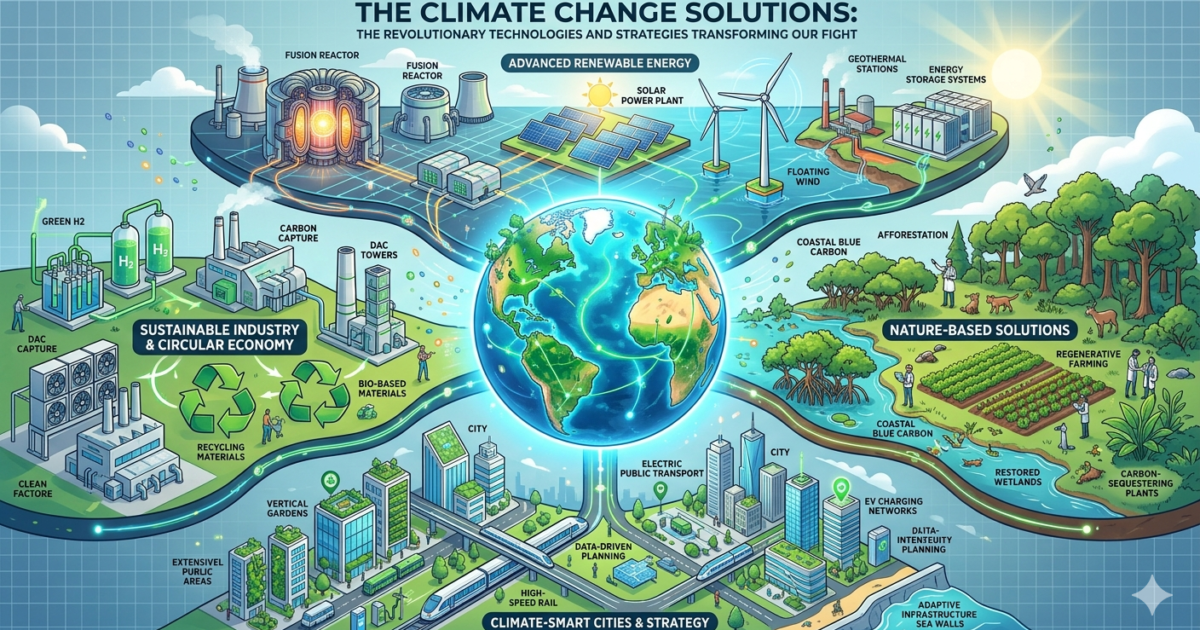
As we stand at a pivotal moment in human history, the year 2026 has emerged as a defining chapter in our battle against climate change. With Earth’s energy budget more out of balance than at any previous time in the observational record and global greenhouse gas emissions reaching a new record of 60.63 billion tonnes of CO₂ equivalent in 2025, the urgency for comprehensive climate change solutions has never been greater. Yet amid these sobering realities, 2026 also represents a year of unprecedented innovation, breakthrough technologies, and transformative strategies that are reshaping our approach to environmental stewardship.
From renewable energy sources that now dominate global power installations to revolutionary carbon capture technologies that can compress millennia of natural processes into hours, the landscape of climate change solutions is evolving at breakneck speed. This comprehensive exploration delves into the most promising developments, cutting-edge innovations, and strategic initiatives that are not just mitigating climate change, but actively reversing its effects.
The Renewable Energy Revolution: Breaking Records and Reshaping Global Power
The renewable energy sector has experienced nothing short of a revolution in recent years, with 2025 marking several historic milestones that are setting the stage for even more dramatic changes in 2026. Global renewable capacity reached 49% in 2025, driven by record solar growth, representing a fundamental shift in how the world generates electricity.
Solar Power: The Undisputed Champion of Clean Energy
Solar energy has emerged as the undisputed leader in the global transition to clean energy. In 2025 alone, about 510 GW of solar capacity was added worldwide, making up nearly three-quarters of all new renewable installations, pushing total global solar capacity to around 2,392 GW by the end of the year. This extraordinary growth trajectory is reshaping energy markets worldwide and demonstrating the technology’s increasing cost-effectiveness and scalability.
The geographic distribution of solar growth reveals interesting patterns that highlight both opportunities and challenges in the global energy transition. Asia’s solar capacity grew sharply from 140 GW in 2016 to more than 1,530 GW in 2025, with China playing a key role by reaching approximately 1,202 GW of installed solar capacity by the end of 2025. This massive deployment in Asia underscores China’s dominant position in renewable energy manufacturing and deployment.
Looking ahead, electricity generation from renewables is expected to increase 60% – from 9,900 TWh in 2024 to 16,200 TWh in 2030, with renewables expected to surpass coal at the end of 2025 (or by mid-2026 at the latest) to become the largest source of electricity generation globally. This transition represents one of the most significant shifts in global energy infrastructure since the Industrial Revolution.
The Broader Renewable Landscape
While solar dominates headlines, other renewable technologies are also experiencing significant growth. 2025 saw total renewable power capacity reach 5,149 gigawatts (GW) after the addition of 692 GW, representing a 15.5% annual increase, with renewable energy dominating total capacity expansion at 85.6% share. This comprehensive growth across multiple technologies creates a more resilient and diversified clean energy ecosystem.
Wind energy continues to play a crucial supporting role in the renewable revolution, with innovative developments pushing the boundaries of what’s possible. A Chinese company launched the first megawatt-level airborne wind turbine—a 60x40x40 m helium-filled aerostat—providing electricity through a tether cable from 2,000 metres above the ground, demonstrating how technological innovation continues to unlock new possibilities for clean energy generation.
In Europe, the renewable energy transition has reached a symbolic milestone. Wind and solar energy provided 30% of EU electricity in 2025, surpassing fossil power (29%) for the first time, generating more power than fossil sources in 14 of 27 EU countries. This achievement represents a fundamental turning point in Europe’s energy system and provides a model for other regions to follow.
Carbon Capture and Storage: From Science Fiction to Commercial Reality
Carbon capture and storage (CCS) technology has transitioned from experimental concepts to commercially viable climate change solutions, with 2025 and 2026 marking critical years for deployment and innovation. Carbon capture and storage is at a turning point, with policy-driven growth in CCS capacity expected to lower costs by about 14% by 2030, mainly due to reductions in capital costs for capture technologies and in transport and storage costs.
Revolutionary Breakthrough: MIT’s Game-Changing Innovation
One of the most significant breakthroughs in carbon capture technology emerged from MIT in late 2025, offering a solution that could dramatically reduce the costs and energy requirements of carbon capture. MIT chemical engineers discovered a simple way to make carbon capture more efficient and affordable by adding a common chemical compound to capture solutions, potentially cutting costs significantly and enabling the technology to run on waste heat or even sunlight instead of energy-intensive heating, using tris to stabilize the pH of the solution used to capture CO2.
This innovation addresses one of the fundamental challenges in carbon capture: energy consumption. The tris addition stabilizes the pH, allowing the solution to absorb triple the amount of CO2, and when heated just slightly to about 60°C, tris quickly releases protons, causing the pH to drop and the captured CO2 to bubble out, enabling the solution to absorb more CO2 at room temperature and release it with mild heating.
Accelerating Natural Processes
Scientists are also finding ways to dramatically accelerate natural climate solutions. Researchers at Hebrew University and Israeli Open University developed a method to speed up geological processes that normally take thousands of years in nature so they happen within hours, published in Environmental Science & Technology. This breakthrough demonstrates how scientific innovation can harness and enhance nature’s own climate regulation mechanisms.
Commercial Deployment and Investment Trends
The commercial deployment of carbon capture technologies is accelerating across multiple sectors. As of early 2025, global operational CO2 capture and storage capacity stood at roughly 50 million tons per annum (Mtpa), though this represents just the beginning of what industry experts expect to be massive expansion.
Large industrial programs such as Germany’s €6 billion industrial decarbonization initiative, including CCS technologies, will start to roll out competitive support mechanisms in mid-2026, with private capital interest also on the rise as major energy companies have entered negotiations to attract infrastructure investment into CCUS assets.
Electric Vehicle Adoption: The Transportation Revolution Accelerates
The electric vehicle revolution continues to transform global transportation systems, with 2025 and 2026 marking years of significant milestones and shifting market dynamics. The global sales share reached approximately 25% in the first half of 2025, up from 21% in 2024, demonstrating sustained momentum despite various economic and policy challenges.
Emerging Markets Lead the Charge
One of the most remarkable developments in electric vehicle adoption is the rapid growth in emerging markets, which are increasingly outpacing established automotive markets. Vietnam has doubled its EV sales share since 2024 to reach close to 40% in 2025, overtaking the UK and the EU for EV sales penetration, while Thailand has exceeded 20% EV sales share for the first time, up from 1% in 2019.
This trend extends beyond Southeast Asia. India, Mexico and Brazil now have a higher EV sales share than Japan, while Indonesia’s EV sales share has reached 15% this year, overtaking the US for EV penetration. These developments challenge traditional assumptions about which markets would lead the electric vehicle transition and demonstrate how supportive policies can enable rapid technology adoption.
Global Market Dynamics and Projections
The overall trajectory for electric vehicle adoption remains strongly positive despite regional variations. EV Volumes forecasts 23.7 million EV sales and a 25.5% market share for 2025, with expectations to rise to nearly 90 million units globally by 2040, accounting for 27.5% of sales in 2026, 43.2% by 2030, and over 83% by 2040.
The diversity of available electric vehicle models continues to expand rapidly. 785 electric car models were available for consumers in 2024, an increase of 15% compared to the previous year, with predictions that 1,000 models will be available by 2026. This expanding choice is crucial for meeting diverse consumer preferences and accelerating adoption across different market segments.
Policy Impacts and Market Resilience
Despite policy uncertainties in some major markets, the electric vehicle transition demonstrates remarkable resilience. A robust pipeline of policies under development in emerging markets like Vietnam, Thailand, Mexico, and India could drive future emissions reductions, helping to offset policy reversals in other regions.
The technology’s improving economics continue to drive adoption. In the United States, owning a light-duty EV is now cheaper than owning a gas-powered car over a vehicle’s lifespan, thanks to ongoing savings from using electricity rather than fuel, less maintenance, and other recurring benefits.
Innovative Climate Technologies: Beyond Traditional Solutions
The fight against climate change is being revolutionized by innovative technologies that go far beyond traditional renewable energy and electric vehicles. These cutting-edge climate change solutions represent the frontier of environmental technology, offering new pathways to carbon reduction and environmental restoration.
Advanced Carbon Removal Technologies
Direct air capture (DAC) technology is moving from pilot projects to commercial-scale operations. Companies such as Climeworks and Deep Sky are working toward expanding DAC facilities, with plans to reach multi-kiloton capture capacities by 2025. These technologies offer the potential to remove carbon dioxide directly from the atmosphere, regardless of the emission source.
Innovative startups are developing novel approaches to carbon removal and storage. Swiss startup Recoal builds a biomass-based carbon dioxide removal technology that processes agricultural and food-industry waste through controlled carbonization, converting biomass under high temperature and pressure into coal-like carbonisate that locks in biogenic carbon, then storing it in shallow or deep underground geological layers.
Artificial Intelligence and Smart Systems
Artificial intelligence is increasingly being integrated into climate solutions, enhancing efficiency and enabling new approaches. AI is increasingly important in advancing sorbent development—helping researchers improve selectivity, durability, and material efficiency, while hybrid systems combine chemical and electrochemical methods to allow for more flexible operation.
Biomass and Waste-to-Value Solutions
Converting waste streams into valuable materials represents another promising frontier. US-based startup CemCycle converts organic waste into carbon-negative construction materials using permanent mineral sequestration, mineralizing carbon in food waste, yard waste, and sewage sludge via energy-positive reactions that transform organic carbon into precipitated calcium carbonate, producing usable energy instead of consuming it.
Policy and Financial Frameworks: Enabling the Transition
The acceleration of climate change solutions in 2026 is supported by evolving policy frameworks and innovative financial mechanisms that create enabling environments for clean technology deployment and scaling.
International Cooperation and Commitments
Global cooperation remains essential for addressing climate change effectively. Climate change requires coordinated solutions at all levels and international cooperation to help countries move toward a low-carbon economy, with the third generation of Nationally Determined Contributions (NDCs), submitted in 2025, being more ambitious than ever.
Innovative Financing Mechanisms
New financial approaches are emerging to address climate challenges, particularly for vulnerable countries. Climate finance innovations such as debt-for-nature swaps are gaining traction, creating fiscal space for low-income countries to invest in resilience, while the New Collective Quantified Goal (NCQG) on Climate Finance aims to deliver $300 billion annually to developing nations by 2035.
The Loss and Damage Fund (LDF), set to begin operations this year, will provide financial assistance to help vulnerable countries recover from climate-induced disasters, representing a significant step forward in climate justice and international solidarity.
Corporate Accountability and Market Mechanisms
New approaches to corporate accountability are gaining momentum. A new campaign known as Make Polluters Pay seeks to hold the fossil fuel industry financially accountable for its role in climate change, pointing out that the oil and gas industry—responsible for more than 40 percent of global greenhouse gas emissions—continues to rake in record profits, averaging more than $3 trillion a year since 2018.
Regional Leadership and Adaptation Strategies
Different regions are taking diverse approaches to climate change solutions, with some emerging as unexpected leaders in specific technologies or strategies.
Nature-Based Solutions and Ecosystem Restoration
Nature-based solutions continue to gain recognition as essential components of comprehensive climate strategies. Conserving and restoring natural spaces, both on land and in the water, is essential to limit carbon emissions and adapt to the changing climate. These solutions offer co-benefits for biodiversity conservation and community resilience while contributing to climate mitigation.
Infrastructure Resilience and Adaptation
Investment in resilient infrastructure is becoming a priority as climate impacts intensify. The United States experienced 14 major weather events—from wildfires to flooding—that caused $101.4 billion in damages in just the first half of 2025, highlighting the urgent need for adaptation measures and resilient infrastructure.
Disaster costs now exceed over $2.3 trillion annually when cascading and ecosystem costs are taken into account, with the Global Assessment Report highlighting how smarter investment can reset the destructive cycle of disasters, debt, un-insurability and humanitarian need.
Challenges and Obstacles: Navigating the Path Forward
Despite remarkable progress in climate change solutions, significant challenges remain that must be addressed to achieve global climate goals.
Geographic Inequality in Clean Energy Access
The benefits of the clean energy transition are not equally distributed globally. Data highlights




Leave a Comment